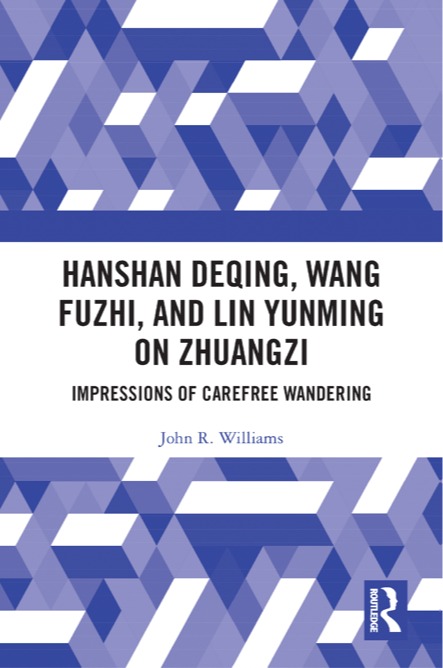
John R. Williams, Hanshan Deqing, Wang Fuzhi, and Lin Yunming on Zhuangzi(Routledge, 2025)
黎江伯著丨憨山德清、王夫之與林雲銘論《莊子》
內容提要
This book provides a glimpse into 17th‑century Zhuāngzǐ (莊子; ca. 4th through 3rd century BCE) studies by introducing the works of Hānshān Déqīng (憨山德清; 1546–1623), Wáng Fūzhī (王夫之; 1619–1692), and Lín Yúnmíng (林雲銘; 1628–1697), which give a sense of diverse approaches to Zhuāngzǐ during this period. The three commentators represent three distinct orientations as reflected by their respective roles, with Hānshān Déqīng being a Buddhist monk, Wáng Fūzhī a philosopher, and Lín Yúnmíng a literary critic. Their understanding of “carefree wandering” (逍遙遊) is spelled out, followed by a complete translation of the Péng–bird 鵬 passage through their eyes. The author concludes how this amounts to a conception of human flourishing. This is the first monograph on Zhuāngzǐ studies of any of these three thinkers in English. General readers or specialists of ancient Chinese philosophy can gain insight into how Zhuāngzǐ was read in culturally relevant contexts. 本書通過介紹憨山德清(1546–1623)、王夫之(1619–1692)與林雲銘(1628–1697)的著作,為讀者提供了一窺十七世紀《莊子》(莊子:約公元前4至3世紀在世)研究風貌的機會,展現了這一時期研究《莊子》的多元路徑。 三位注家代表了三種不同的學術取向,這與其各自的身份角色相呼應:憨山德清為佛教僧人,王夫之為哲學家,林雲銘則為文學批評家。本書首先闡明他們對“逍遙遊”的理解,隨後呈現了經由這三位注家視角所見的“鵬”之段落的完整翻譯。作者在結論部分總結了這種解讀如何牽引出一種關於人類幸福感的提升的觀念。 這是首部以英文撰寫的、關於這三位思想家之《莊子》研究的專著。普通讀者或中國古代哲學領域的專業學者均可從中瞭解《莊子》在與其相關的文化語境中是如何被解讀的。
目錄
Contents Preface vii 1 A Point of Departure 1 2 An Introduction to Hānshān Déqīng’s Zhuāngzǐ Studies 27 3 An Introduction to Wáng Fūzhī’s Zhuāngzǐ Studies 61 4 An Introduction to Lín Yúnmíng’s Zhuāngzǐ Studies 94 Epilogue: Brief Comparative Sketches 122 Abbreviations 131 Selected Bibliography 133 Index 137 目錄序言 vii 1 起點 1 2 憨山德清《莊子》研究導論 27 3 王夫之《莊子》研究導論 61 4 林雲銘《莊子》研究導論 94 結語:比較性速寫 122 縮略語表 131 參考文獻選編 133 索引 137
作者簡介
John R. Williams currently teaches at the Chinese University of Hong Kong, Shenzhen, and was recently selected for the Shenzhen Peacock Talent Program. He obtained his Ph.D. in Chinese Philosophy from the National University of Singapore, where he was awarded the President’s Graduate Fellowship. 黎江伯現執教於香港中文大學(深圳),近期入選深圳市孔雀人才計劃。他在新加坡國立大學獲得中國哲學博士學位,並曾獲頒校長研究生獎學金。