
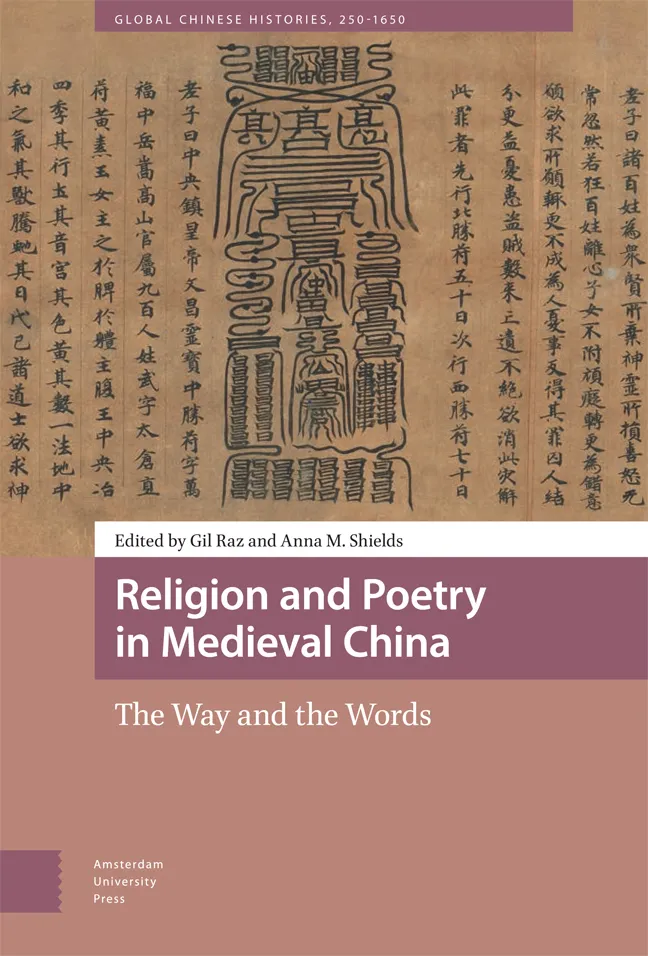
Gil Raz and Anna M. Shields (eds.), The Way and the Words: Religion and Poetry in Medieval China, Amsterdam University Press, 2023.
內容提要
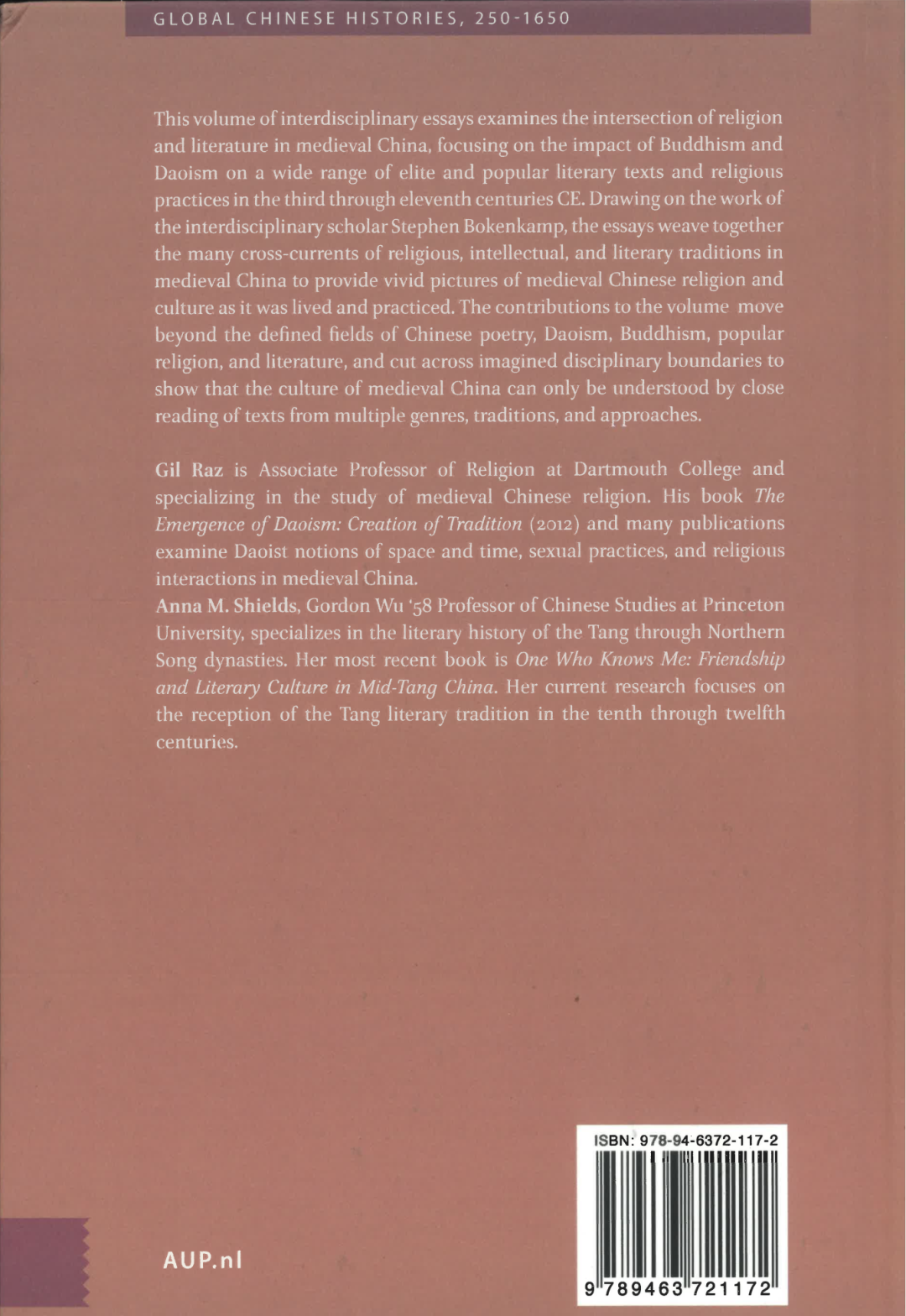
Studies of the ancient Chinese classics, medieval Chinese history, Buddhism, Daoism, poetry, and prose have all too often been constrained within traditional disciplinary silos, such as literature, politics, philosophy, art, and religion. As a consequence, historians have infrequently read religious texts, scholars of Tang poetry have rarely engaged with archeological and epigraphic materials, while scholars of Buddhism have not often explored Daoist materials. Authors and readers in medieval China were of course not constrained by such boundaries. On the contrary, government and military officials, historians, poets, Buddhists, Daoists, and authors of tomb epitaphs and of imperial inscriptions shared cultural interests, and medieval authors read and found inspiration in each other’s diverse works. Our contemporary disciplinary labels tend to simplify the identities of medieval Chinese people—as adherents to a particular religion, or writers of a specific literary form—and thereby occlude the reality of their intertwined, multiple cultural practices. Indeed, people were rarely restricted to a single social identity or narrow set of cultural interests. But the blind spots in our understanding of medieval Chinese culture are not merely a result of contemporary disciplinary views: they are also shaped by the contours and gaps in the textual archive as it was transmitted and refashioned by centuries of readers. The surviving textual record from early and medieval China represents only a minute portion of the cultural productions of this era. In order to create a richer understanding of lived medieval culture, including the intersections of religious and literary practices, we need to not only read across the grain of modern disciplinary categories but also to expand our source base to include epigraphic and artistic materials, among others that have survived outside orthodox compilations of literary and scriptural traditions.
針對中國古代經典、中古中國歷史、佛教、道教、詩歌與散文的研究常常被禁錮在諸如文學、政治、哲學、藝術、宗教等傳統學科的倉儲之中。其結果是,史學家很少閱讀宗教文獻,唐詩學者很少接觸考古與碑刻材料,而佛教學者則往往不去探索道教典籍。當然,中古中國的作者和讀者並不受此類界囿的約束。相反,政府與軍事官員、史學家、詩人、佛教徒、道教徒,以及墓誌銘和皇帝碑文的作者們,有著共通的文化旨趣; 中古的作者們閱讀彼此不同的作品,並從中獲得靈感。我們當代的學科標籤傾向於簡化中古中國人的身份——將其簡化為某一特定宗教的信徒,或某種特定文學形式的作者——從而遮蔽了他們相互交織、多元文化實踐的實情。誠然,人們很少被局限於單一的社會身份或狹隘的文化旨趣之中。但是,我們理解中古中國文化時的盲點,並不僅僅是當代學科視野的結果; 它們同樣也為文獻檔案的輪廓與界線所塑造,而這些檔案是歷經數個世紀的讀者傳承和重塑而來的。從上古至中古中國倖存下來的傳世文獻記錄,僅代表了該時代文化產出的極小一部分。為了更豐富地理解活態的中古文化,包括宗教與文學實踐的交匯,我們不僅需要挑戰現代學科的既定分類,還必須拓展我們的史料基礎,將碑刻、藝術材料,以及其他在正統的文學與經典傳統編纂之外倖存下來的資料囊括進來。
The subtitle of this volume, “The Way and the Words,” points to a fundamental critique of our very project. The Dao, the Way, is formless and nameless; it is the “teaching without words.” However, as humans we are forced to use words to communicate, and we are constrained within specific language and script communities. People in medieval China sought to attain the Way, and they realized that their words were mere traces of the ineffable. And yet, as the poems, inscriptions, scriptures, and commentaries explored in this volume demonstrate, medieval people continually sought to use words to trace the ineffable, and their ceaseless efforts to do so require our careful, attentive reading.
本書的副標題“道與言”,指向了對我們這項事業本身的一個根本性批判。道,是無名無形的; 它是“無言之教”。然而,作為人類,我們被迫使用語言來交流,並且受限於特定的語言和文字社群。中古中國人追求得道,他們認識到自己的言語僅僅是那不可言說的存在所存留之跡。然而,正如本書所探討的詩歌、碑文、經典和註釋所展示的那樣,中古中國人不斷地嘗試用言語來描摹那不可言說的存在,而他們不懈的努力,需要我們細緻而專注地閱讀。
Table of Contents 目錄
Conventions for Frequently Cited Works 常用引文體例說明
Introduction 引言(Gil Raz and Anna M. Shields)
1. Brushing Past Rainbows: Religion and Poetry in the Xu Mi Stele “捫景帶虹”:許謐碑中的宗教與詩歌 (J. E. E. Pettit)
2. Li Bo and Hu Ziyang: Companions of the Way 李白與胡紫陽:同道之侶(Paul W. Kroll)
3. The Vicarious Angler: Gao Pian’s Daoist Poetry 寄情煙波:高骈的道教詩歌 (Franciscus Verellen)
4. Traces of the Way: The Poetry of “Divine Transcendence” in the Northern Song Anthology Literature’s Finest道之跡:北宋文集《文萃》中的“神仙”詩 (Anna M. Shields)
5. A Re-examination of the Second Juan of the Array of the Five Talismans of the Numinous Treasure《太上靈寶五符序》第二卷再考 (Wang Zongyu 王宗昱, translated by Gil Raz)
6. “True Forms” and “True Faces”: Daoist and Buddhist Discourse on Images “真形”與“真容”:道教與佛教關於圖像的論述 (Gil Raz)
7. After the Apocalypse: The Evolving Ethos of the Celestial Master Daoists 劫餘:天師道道士演變中的道德(Terry Kleeman)
8. Shangqing Scriptures as Performative Texts 作為表演性文獻的上清經 (Robert Ford Company)
9. My Back Pages: The Sūtra in Forty-Two Chapters: Revisited 我的“陳年舊事”:《四十二章經》再探 (James Robson)
10. Taking Stock 總結 (John Lagerwey)
Epilogue 結語
Traversing the Golden Porte—The Problem with Daoist Studies (Stephen R. Bokenkamp)
飛越金闕——道教研究的問題
Index 索引
Editors 編者簡介
Gil Raz
Gil Raz is Associate Professor of Religion at Dartmouth College specializing in the study of medieval Chinese religion. His book The Emergence of Daoism: Creation of Tradition (2012) and many publications examine Daoist notions of space and time, sexual practices, and religious interactions in medieval China.
李福:達特茅斯學院宗教學系副教授,專攻中古中國宗教研究。其著作《道教的興起:傳統的創造》(2012)及多篇論文探討了中古中國道教的空間與時間觀念、房中術以及宗教間的互動。
Anna Shields
Anna M. Shields, Gordon Wu ’58 Professor of Chinese Studies, Princeton University, specializes in the literary history of the Tang through Northern Song. Her most recent book is One Who Knows Me: Friendship and Literary Culture in Mid-Tang China (2015); current research examines the reception of Tang literature, 10th-11th centuries.
田安:普林斯頓大學 Gordon Wu’58 中國研究講席教授,專長於唐代至北宋的文學史。其最新著作為《知我者:中唐中國的友誼與士人文化》(2015); 目前的研究考察10-11世紀唐代文學的接受情況。
(供稿:呂陳童)
