
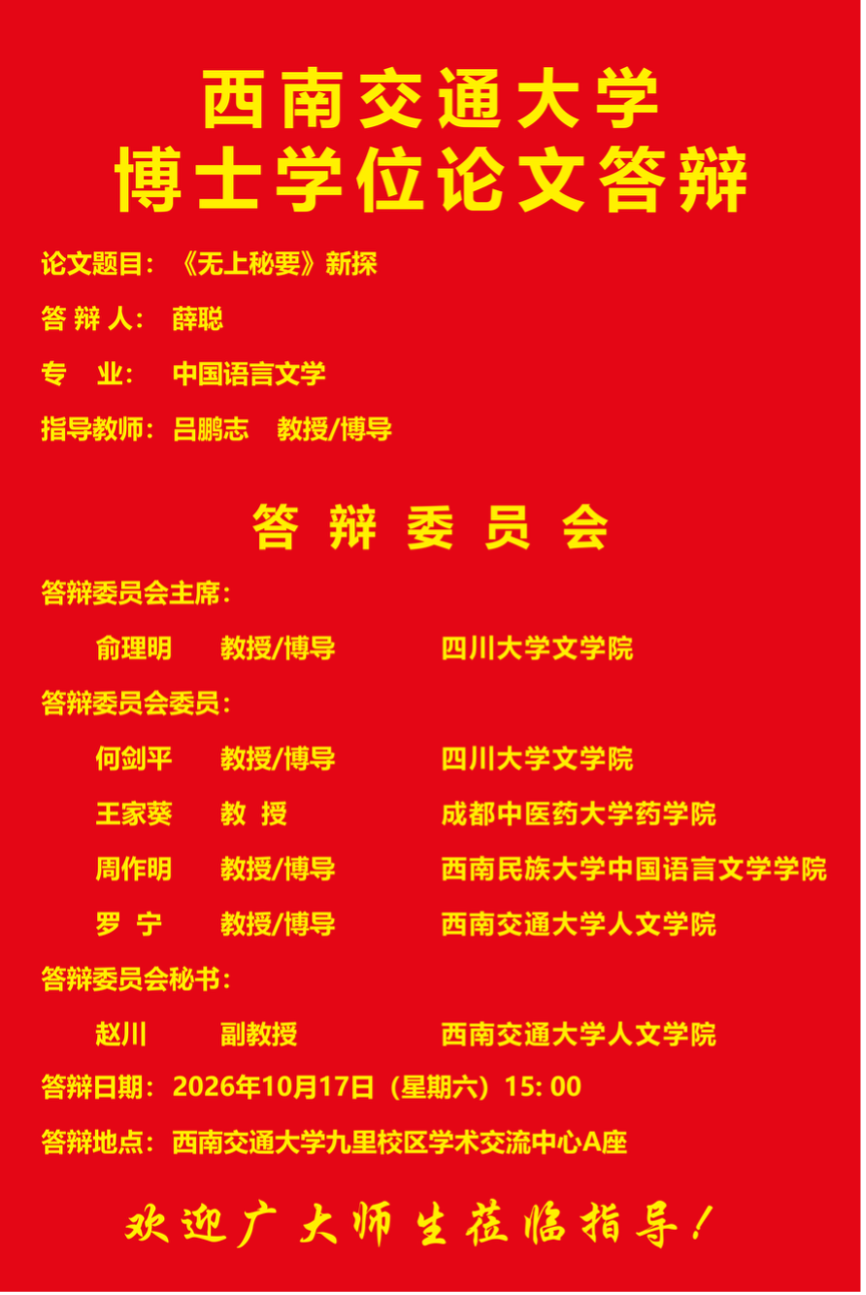
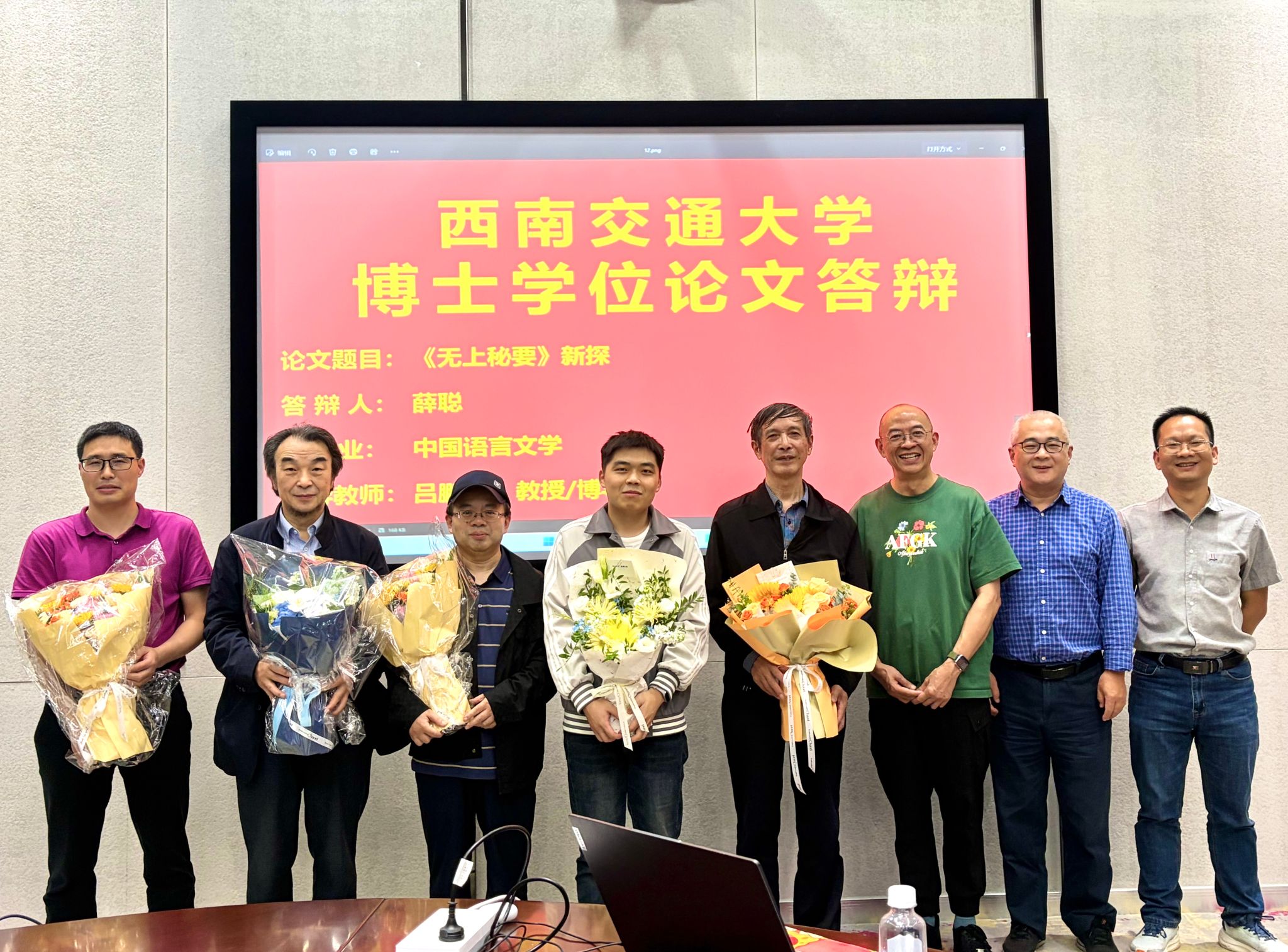
2026年10月17日15:00-18:30,西南交通大學人文學院博士研究生薛聰的博士學位論文答辯會在我校九里校區學術交流中心A座同炎廳舉行。答辯委員會由四川大學文學院俞理明教授(主席)、何劍平教授,成都中醫藥大學藥學院王家葵教授,西南民族大學中國語言文學學院周作明教授,西南交通大學人文學院羅寧教授、趙川副教授(答辯秘書)組成。薛聰同學的導師呂鵬志教授出席了答辯會,西南交通大學人文學院部分碩、博研究生及博士後研究人員旁聽了此次答辯會。
薛聰同學的博士論文《〈無上秘要〉新探》綜合運用文獻學、歷史學、宗教學的方法,充分吸收國內外研究成果,對北周道教類書《無上秘要》進行深度整理和研究,全文逾80萬字。
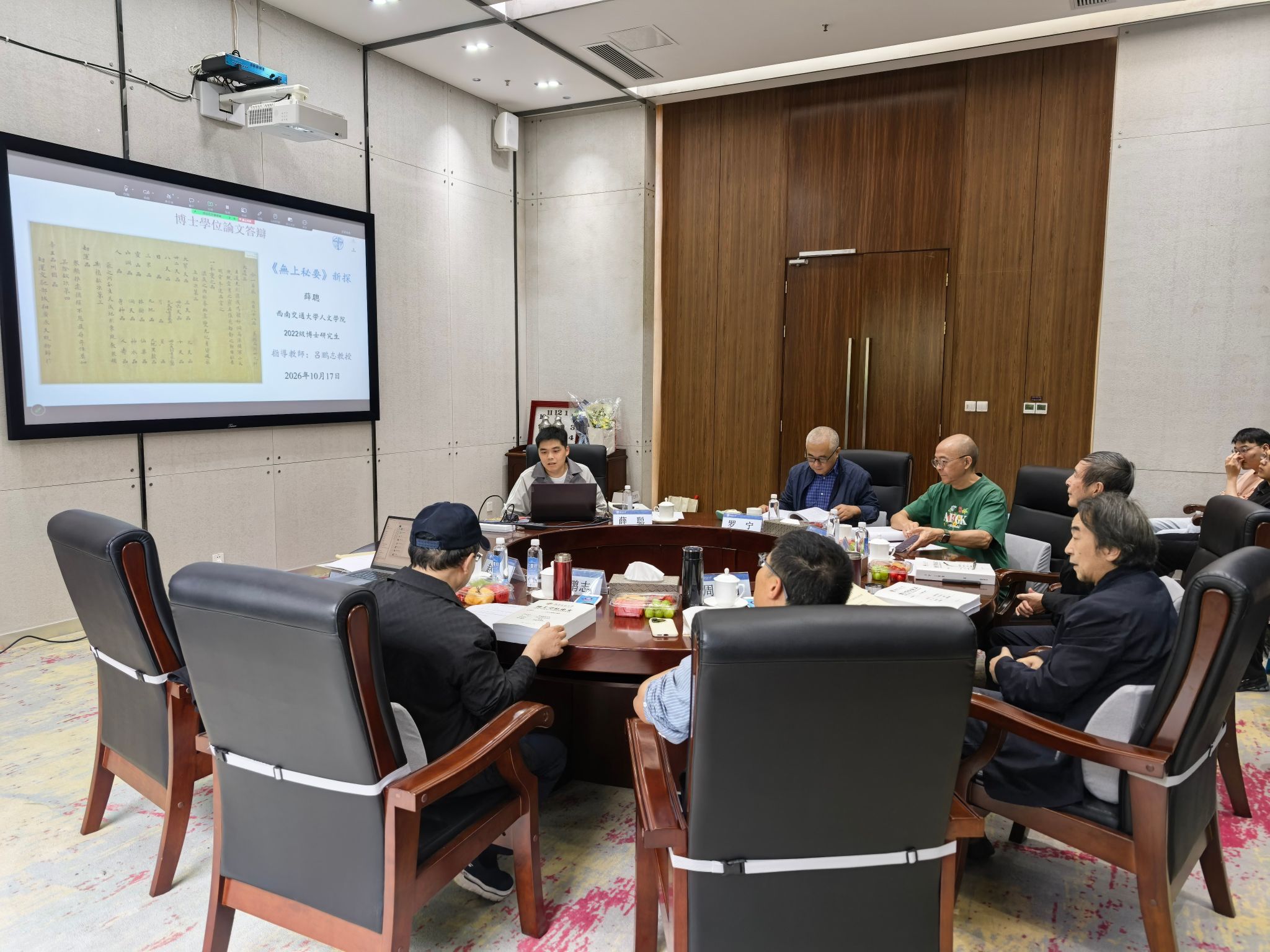
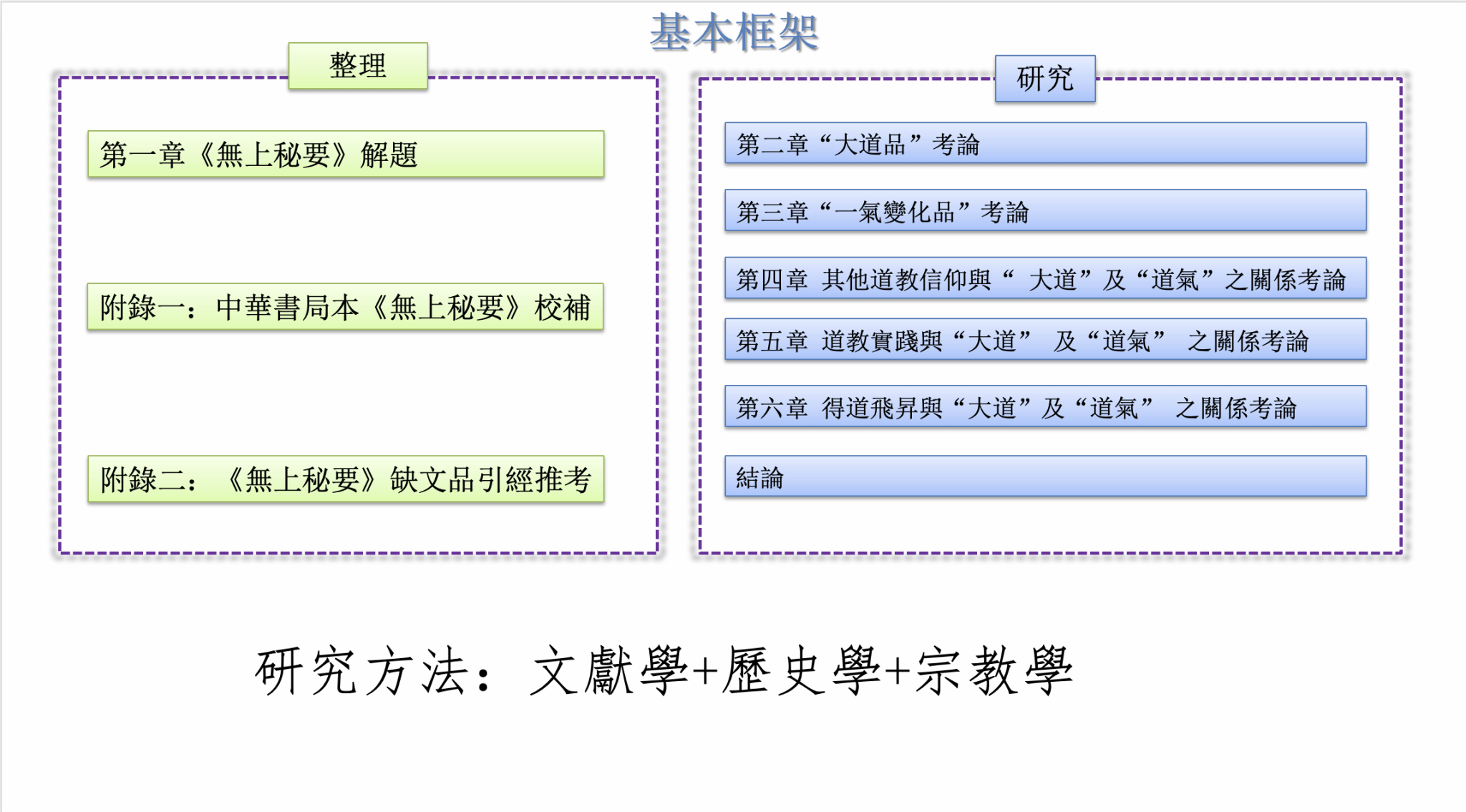
在個人陳述環節,薛同學指出學界有關《無上秘要》的研究非常多,在歷史學(如成書背景、編纂過程、與北周政權關係等問題)、文獻學(引文被多次比定、統計,多個敦煌寫本被考訂著錄,中華書局推出了點校本)、宗教學(敦煌本《無上秘要目錄》反映的道教教義體系已被反覆討論)等方面取得了諸多成果。但仍然存在四個尚待研究的問題:①點校本《無上秘要》還可作進一步修訂;②《無上秘要》諸多缺文品未被研究;③過去對道教宗教體系的闡述主要依靠敦煌本《無上秘要目錄》,而很少結合《無上秘要》內部各處引文深入探討;④尚未從《無上秘要》誕生的歷史背景來深度討論其中所呈現的道家哲學與道教之關係。由此,博士論文的基本框架有二。一是整理(包括第一章、附錄一、附錄二),解決前兩個問題。二是研究(包括第二章至第六章以及結論),涉及後兩個問題。隨後,薛同學對從解題、校勘、缺文品引經推考、《無上秘要》宗教體系考論、結論等方面對論文進行了概述。
陳述完畢後,答辯委員會專家高度肯定了薛聰同學的博士論文,同時也提出了一些修改建議和未來可進一步研究的方向。
周作明教授指出,緒論部分對於南北朝道教交流,尤其是南方道經如何傳到北方可以再詳細描述。文中“北方道教南方化”的提法似乎可以再商榷。《無上秘要》的編撰思想體現在何處可以說得詳細一些。此外,文中似乎缺少了與《中國道教史》及《中國道教思想史》的對話。
何劍平教授指出文中提到東漢支婁迦讖所譯《大阿彌陀經》,不知何據。另外,文中也有一些可以進一步討論的話題,如《無上秘要》中的誦經、齋儀等實踐以及校對功過的觀念可以深入與佛教比較。又如《無上秘要》中有“靈山品”,考釋此品時可以追溯一下“靈山”出現的時間,並考慮與佛教靈山的比較。再如第130頁引用《道教義樞》中的“由迹顯本”“攝迹歸本”,亦可追溯一下“本”“迹”關係論題出現的年代。
王家葵教授指出論文在校勘《無上秘要》時,提到涵芬樓影印本《無上秘要》作“修”,宮內廳藏《道藏》本及青島市博物館藏《道藏》本作“老”,二字差異極大,需要檢查國圖本《道藏》作何字,以便討論修版問題。至於討論《無上秘要》中的“道教”,建議再增加一些內容,如探討《無上秘要》裁剪文獻時所秉持的觀念以及《無上秘要》對後世道教宗教體系的影響。
羅寧教授指出論文第二章第二節第二小節將“大”和“無”作為哲學概念來討論,但需要注意,在道家哲學中“大”多是形容詞,“無”也不能完全等於“道”,建議改為“道家的無形道論”,並對內容進行修改。論文校勘部分認為“八素”是“八索”之訛,但需要注意“素”“索”二字在古代常常混用。此外,第628頁,“穎川人”應改為“潁川人”。
俞理明教授指出薛同學論文的體量太大,故而腳注非常多,可能不方便讀者閱讀,建議引用的原始材料隨文出注。文末的參考文獻格式建議需再調整。此外,緒論部分在討論類書的特性時,還需補充論述類書的“主題性”。
薛聰同學對各位專家的提問與建議表示感謝,他表示會認真吸收各位專家的意見,修改論文。他也對部分問題進行了回答。薛同學指出,南方道經大約在五世紀後期開始北傳,對比《魏書·釋老志》與《無上秘要》,可以發現六世紀的北方道教吸收南方道經有一個漸進過程。《無上秘要》主要引用南方道經,裡面很少有明顯的北方道教色彩,故而用“北方道教南方化”這一提法。當然,在當時的道教造像中還大量存在北方道教的元素,並非全盤南方化。《無上秘要》的編撰思想主要體現在品目結構、引文排列、裁剪修改引文等三個方面,文中各章有所涉及,但未專論。關於《大阿彌陀經》的問題,薛同學表示它指舊題“支謙譯”《佛說阿彌陀三耶三佛薩樓佛檀過度人道經》,說它是支婁迦讖所譯,是參考了那體慧(Jan Nattier)《初期漢譯佛經指南》(A Guide to the Earliest Chinese Buddhist Translations)一書。
問答環節之後,導師呂鵬志教授介紹了薛聰同學研究生階段的課程學習情況,並宣讀了推薦意見及對論文的學術評語。呂教授指出,薛同學不僅參加了他在新冠疫情期間面向全球學子開設的“中國宗教文獻”及“道教儀式”兩門網課,還參加了他組織的一系列與道家哲學、天師道經典、古靈寶經、上清經有關的讀書會,這為他撰寫博士論文打下了堅實的基礎。《〈無上秘要〉新探》一文體大思精,將哲理思辨與文史考據融於一爐,在觀點、方法和材料三個方面均有重要突破和創新。
答辯委員會一致認為,薛聰同學的博士論文《〈無上秘要〉新探》充分吸收中國、日本、歐美等國內外相關學術成果,廣泛搜集《道藏》、敦煌道經及佛教文獻等資料,將《無上秘要》的研究推向了全新高度。論文結構嚴謹、材料豐富、論證扎實、行文流暢、新見迭出,對於瞭解中古道教宗教體系及構建中國道教研究自主知識體系,具有重要參考價值。經無記名投票,答辯委員會全票通過答辯,建議授予薛聰文學博士學位,推薦評選優秀博士學位論文。
附:薛聰博士論文《〈無上秘要〉新探》摘要
《無上秘要》是由北周(557—581)武帝宇文邕(543—578)敕令道士編纂的一部道教類書,全書共一百卷,文字內容按照主題分爲二百八十八品,諸品又按所屬義類分爲四十九科。武帝在位期間(560—578),多次主持儒、釋、道三教論衡,討論“三教義”及“三教先後”等核心議題,意圖藉由文化上的整合爲政治上的統一奠定基礎。在三教論衡中,佛道二教之間交鋒尤爲激烈。例如,甄鸞所著《笑道論》和道安所撰《二教論》皆對道教展開了批評。佛教徒往往指責道教不僅背離了以老莊爲代表的道家哲學,還剽竊了佛教的教義,進而批判道教的各種信仰及實踐活動都是愚昧、粗鄙、虛妄、混亂且邪惡的,斷言道教沒有成爲國家正教的資格。然而,武帝本人信仰道教,且判定道教居於佛教之上,故並不同意佛教徒的批評。在此背景下,《無上秘要》肩負的主要任務就是構建起統一的、精緻的、不同於佛教徒所批評的、符合武帝文化政策的“道教”,以證明道教在大周帝國存在的正當性。本文即在細緻整理《無上秘要》的基礎上,探究什麼是《無上秘要》中的“道教”。主體分爲六章,要旨略述如下。
第一章詳細介紹《無上秘要》的編纂背景、成書年代、編者群體、歷代著録、現存版本、書名釋義、內容提要、資料來源、體例淵源、對後世的影響以及引録方式等內容。此章連同附録一“中華書局本《無上秘要》校補”與附録二“《無上秘要》缺文品引經推考”均屬文獻整理工作,旨在爲後續章節的深入探討奠定堅實的研究基礎。
第二章以敦煌本《無上秘要目録》第一科之科義爲綫索,深入考論《無上秘要》首品“大道品”的內涵。“大道品”完全繼承了道家哲學的“道本論”思想,將“大道”確立爲宇宙之本根。“大道品”統攝《無上秘要》中的其他品目,在《無上秘要》所構建的宗教體系中具有核心地位。
第三章以敦煌本《無上秘要目録》第二科之科義爲綫索,深入考論《無上秘要》第二品“一氣變化品”的內涵。“一氣變化品”的教理依據是《老子》第四十二章“道生一,一生二,二生三,三生萬物”的宇宙生成論,思想淵源則是戰國中後期以來黃老學的“氣本論”思想。在黃老學“以氣釋道”的影響下,道教發展出了“道氣”這一概念,相當於此品中的“一氣”。根據“大道品”與“一氣變化品”的先後次序,“道”與“氣”存在兩種關係:一是從終極本根的層面來看,“道”先於“氣”,唯有“大道”才是宇宙得以生成的終極依據;二是就宇宙生成的具體過程而言,“道”即是“氣”,無形無象之“大道”創生萬有,實質上表現爲“道氣”生化萬物。由此可見,“道氣”也在《無上秘要》的宗教體系中居於核心地位。
第四章研究《無上秘要》第三科至第二十六科中的信仰類品目。著重考論其中呈現的天界觀、地界觀、劫運觀、人類觀、神靈觀、天書觀。這些觀念均建構於“大道”和“道氣”的核心信仰之上。
第五章研究《無上秘要》第二十七科至第四十六科中的實踐類品目。此章借鑒劉宋(420—479)道士陸修靜(406—477)於《靈寶經目》中提出的十二部分類體系,選取其中與道教實踐高度相關的威儀、表奏、玉訣、戒律、方法、衆術等六個部類作爲分析框架,深入探討《無上秘要》中的這些實踐活動與“大道”和“道氣”之內在關係。此章另有兩則補論,以深化對《無上秘要》中道教儀式的探討。補論一指出《無上秘要》“御製新儀”所見符籙被道士視作“天書”,皆由“道氣”凝結而成。補論二從“齋戒品”所見“賃人破齋”故事入手,通過比較東漢(25—220)康孟祥所譯《中本起經》中的原型故事,證明道教齋儀有其佛教淵源。
第六章研究《無上秘要》第四十七科、第四十八科以及第四十九科中的得道類品目。此章從得道階位、飛昇過程、終極境界三方面,系統闡明得道類品目與“大道”和“道氣”之間的深層聯繫。
結論指出,《無上秘要》建構了一套“信仰(信道)—實踐(行道)—得道(歸道)”的完整宗教體系。《無上秘要》中的“道教”全面繼承並深化了道家哲學的“道本論”和“氣本論”,《無上秘要》將道家哲學作爲教理基礎,並不與道家哲學相悖。儘管《無上秘要》中含有諸多佛教元素,但已被轉化爲“道教”的有機組成部分,因爲在當時的道士看來,佛教不過是神格化“大道”所施設的一種教化形態。由此可見,《無上秘要》建構的“道教” 絶非佛教徒所理解的“道教”。《無上秘要》中的“道教”是以“大道”和“道氣”爲核心信仰,以道家哲學爲教理基礎,廣泛融攝佛教和儒教元素,具有完備宗教形態的中國本土高級宗教。全面深入地研究《無上秘要》有助於深入認識和理解自中古時代一直傳承到當代的道教。
ABSTRACT
The Wushang biyao (Essentials of the Supreme Secret) is a Daoist encyclopedia compiled by Daoists at the behest of Emperor Wu of the Northern Zhou dynasty(557–581), Yuwen Yong (543–578). The complete work comprises 100 juan, with its textual content divided thematically into 288 sections, which, according to their respective doctrinal categories, are further grouped into 49 divisions. During his reign (560–578), Emperor Wu frequently presided over debates among the Three Teachings—Confucianism, Buddhism, and Daoism—addressing core issues such as the “tenets of the three teachings” and “the correct order of the three teachings”, intending to lay a foundation for political unification through cultural integration. Within these debates, the clashes between Buddhism and Daoism were especially fierce. For example, Zhen Luan’s Xiaodao Lun(Laughing at the Dao) and Dao’an’s Erjiao Lun (Treatise on the Two Teachings) both launched attacks against Daoism. Buddhists often accused Daoism not only of deviating from the Daoist philosophy represented by Laozi and Zhuangzi but also of plagiarizing Buddhist doctrines. They further denounced the beliefs and practices of Daoism as ignorant, vulgar, delusional, chaotic, and evil, asserting that Daoism lacked the qualifications to become a state religion. However, Emperor Wu himself believed in Daoism and ruled that it was superior to Buddhism, thus disagreeing with the Buddhists’ criticism. Against this background, the primary task undertaken by the Wushang biyao was to construct a unified, sophisticated form of “Daoism” that differed from the one criticized by Buddhists and aligned with Emperor Wu’s cultural policies, thereby demonstrating the legitimacy of Daoism within the Great Zhou Empire. On the basis of a meticulous textual collation of the Wushang biyao, this dissertation investigates its definition of “Daoism”. The main body is divided into six chapters, of which the essential arguments are summarized below.
Chapter One provides a detailed introduction to the compilation background, date of completion, group of compilers, bibliographic records, extant editions, explanation of the title, content summary, source materials, stylistic origins, influence on later periods, and modes of citation of the Wushang biyao. This chapter, together with Appendix One (“Corrections and Supplements to the Zhonghua Shuju Edition of the Wushang Biyao”) and Appendix Two (“An Investigation of Scriptures Cited in Missing Sections of the Wushang biyao”), constitutes foundational textual research, aiming to establish a solid basis for the in-depth discussions in subsequent chapters.
Chapter Two uses the definition of the theme of the first division, preserved in the Dunhuang manuscript of the Wushang biyao table of contents, as a clue to conduct an in-depth examination of the connotations of the first section, “Dadao pin” (Section on the Great Dao). This section fully inherits the Dao-centered theory of Daoist philosophy, establishing the “Great Dao” as the fundamental root of the universe. This section subsumes all other sections within the Wushang biyao and occupies a core position in the religious system constructed by the text.
Chapter Three uses the definition of the theme of the second division, preserved in the Dunhuang manuscript of the Wushang biyao table of contents, as a clue to conduct an in-depth examination of the connotations of the second section, “Yiqi bianhua pin” (Section on the Transformations of the One Qi). The doctrinal basis for this section is the cosmogony found in Chapter 42 of the Laozi: “The Dao gives birth to One; One gives birth to Two; Two gives birth to Three; Three gives birth to the myriad things.” It derives from the Qi-centered theory of Huang-Lao thought that developed from the mid-to-late Warring States period onward. Under the influence of the Huang-Lao approach of “interpreting the Dao through Qi”, Daoism developed the concept of “Dao-Qi” (the pneumas of the Dao), which corresponds to the “One Qi” in this section. According to the sequential order of the “Dadao pin” and the “Yiqi bianhua pin”, the relationship between “Dao” and “Qi” is twofold: First, on the ontological level, “Dao” precedes “Qi”; only the “Great Dao” is the ultimate foundation for the generation of the universe. Second, regarding the cosmic process, “Dao” is none other than “Qi”; the creation of all existence by the formless “Great Dao” is essentially manifested as “Dao-Qi” generating and transforming the myriad things. This indicates that “Dao-Qi” also occupies a core position in the religious system of the Wushang biyao.
Chapter Four examines the sections concerning beliefs found within the third to twenty-sixth divisions of the Wushang biyao. It offers a critical study of the concepts of the celestial and terrestrial realms, cosmic cycles and kalpas, humanity, deities, and celestial writs presented in these sections. These concepts are all constructed upon the core beliefs of the “Great Dao” and “Dao-Qi”.
Chapter Five examines the sections concerning practices found within the twenty-seventh to forty-sixth divisions. This chapter draws upon the twelve-part classification system proposed by the Liu-Song dynasty (420–479) Daoist master Lu Xiujing (406–477) in his Lingbao jingmu (Catalogue of Lingbao Scriptures), selecting six categories highly relevant to Daoist practice—Weiyi(Solemn Rites), Biaozou (Memorials and Petitions), Yujue (Jade Instructions), Jielü (Precepts and Rules), Fangfa (Technical Methods), and Zhongshu (Miscellaneous Techniques)—as an analytical framework to investigate thoroughly the intrinsic relationship between these practices and the “Great Dao” and “Dao-Qi”. This chapter also includes two supplementary discussions to deepen the exploration of Daoist ritual in the Wushang biyao. Supplementary Discussion One points out that talismans and registers seen in the “Imperially Commissioned New Rituals” of the Wushang biyao were regarded by Daoist priests as “celestial writs”, all congealed from “Dao-Qi”. Supplementary Discussion Two begins with the story of a servant breaking the observance of the fast found in the “Zhaijie pin” (Section on Fasting and Precepts), and through comparison with a prototype story in the Zhong benqi jing (Middle-length Scripture on Former Events) translated by the Eastern Han(25–220) translator Kang Mengxiang, demonstrates that Daoist fast ritual has Buddhist origins.
Chapter Six examines the sections concerning attaining the Dao in the forty-seventh, forty-eighth, and forty-ninth divisions of the Wushang biyao. This chapter systematically elucidates the profound connections between these sections and the “Great Dao” and “Dao-Qi” from three aspects: the ranks of those who attained the Dao, the process of ascension, and the ultimate spiritual realm.
The conclusion argues that the Wushang biyao constructs a complete religious system of “belief (having faith in the Dao)—practice (practicing the Dao)—attainment (returning to the Dao)”. The “Daoism” in the Wushang biyao comprehensively inherits and deepens the Dao-centered and Qi-centered theories of Daoist philosophy. The Wushang biyao takes Daoist philosophy as its doctrinal basis and does not contradict it. Although the Wushang biyao contains numerous Buddhist elements, they have been transformed into integrated components of “Daoism”, because, from the perspective of the Daoists of that time, Buddhism was merely a form ofteaching dispensed by the deified “Great Dao”. This reveals that the “Daoism” constructed by the Wushang biyao is by no means the “Daoism” understood by Buddhists. The “Daoism” in the Wushang biyao is a fully developed, indigenous Chinese high religion with the “Great Dao” and “Dao-Qi” as its core beliefs, Daoist philosophy as its doctrinal foundation, and extensive integration of Buddhist and Confucian elements. A comprehensive and in-depth study of the Wushang biyao helps us to understand and appreciate the Daoism that has been transmitted from the medieval era down to the present day.
(供稿:趙川、趙允嘉)
